🎶Hello WordPress, my old friend. I’ve come to write with you again.🎶
Hello there! It’s been a hot minute since I last wrote anything on my site and a lot has changed in that time. I’ve grown in many areas of my life through various lived experiences, and with that in mind, I wanted to share my recent experience with a music learning platform company that forced me to learn what rights a musician has when it comes to signing a contract. I will refrain from naming them, as the purpose of this blog post is meant to inform and educate other musicians of what their rights are as a musician so that they (hopefully) won’t experience any possible negative impacts on their intellectual property through signing a contractual agreement. I hold immense gratitude towards this business for allowing me to learn everything that I did learn from this experience. Let’s get into it!
To set the stage (no pun intended), in early February of 2026, I had applied to an job posting on LinkedIn looking for musicians as a volunteer or internship. After numerous back and forth messages through LinkedIn and email attempting to set up a meeting, we managed to finally connect on March 2, 2026 via Google Meets. We discussed what the company was all about, the relationship, and various other items, including mentioning the possibility of sponsors in the future as a means to pay the contributors. Later that evening, I received a Word document for a Volunteer Content Creator Agreement. I read through the document the very same day I had received it and there was something that seemed off about it, yet I couldn’t quite put my finger on it. After having it reviewed by legal counsel, my suspicions were proven to be correct, and fortunately, the document was never signed by any party, especially on my part.
Here’s a copy of the contract, with any sensitive/identifying information removed:
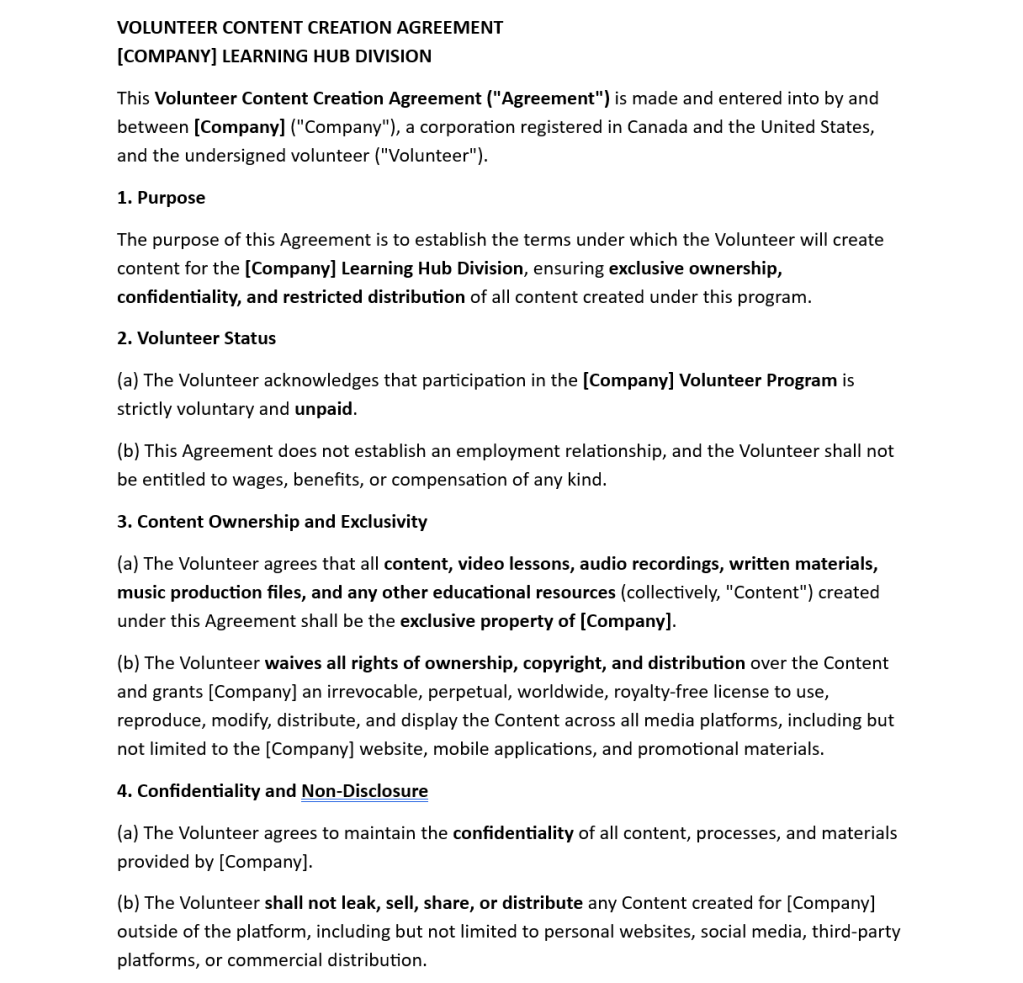
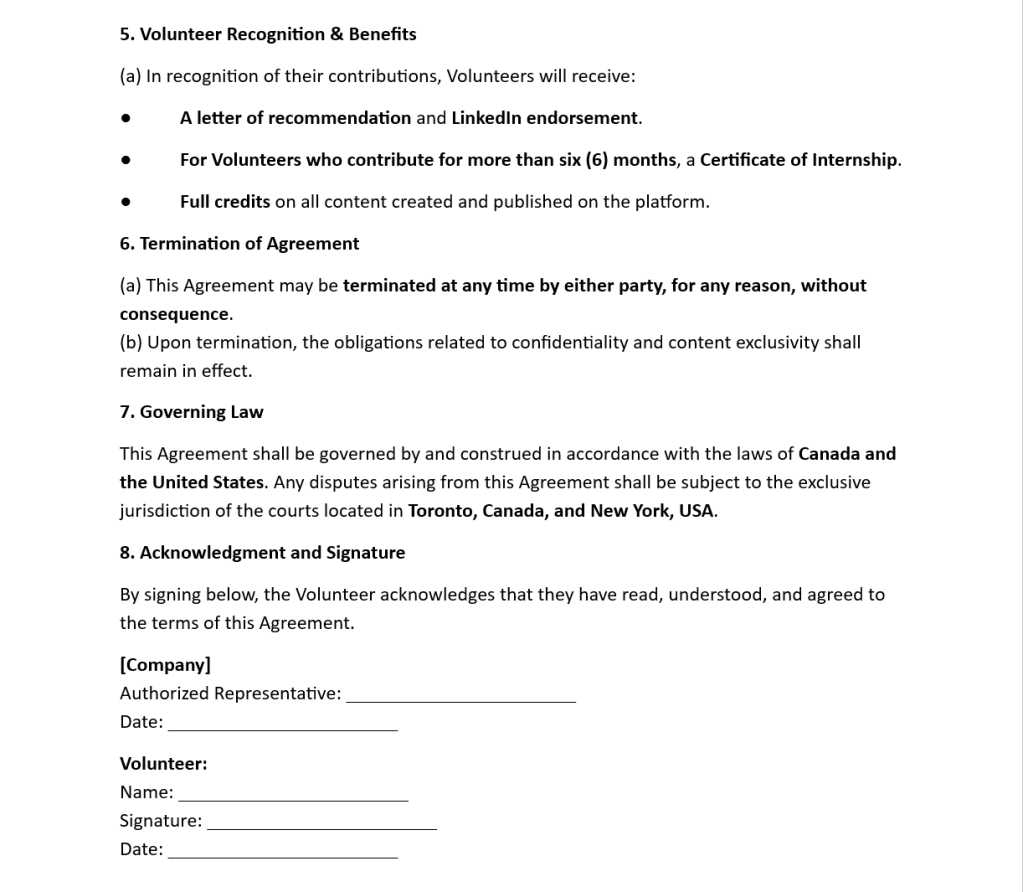
Typically, a person would start at the top and work their way down to the bottom of the document to identify the issues. In this case, one of the most important issues resides at the bottom of the document, since it directly affects everything else that is contained within the document itself.
7. Governing Law:
“the laws of Canada and the United States” + “the exclusive jurisdiction of the courts located in Toronto, Canada, and New York, USA“
++++ These statements are inherently/internally contradictory and ambiguous. It is legally impossible to have “exclusive” jurisdiction in two separate countries’ courts simultaneously. This creates competing/conflicting forum clauses that courts often refuse to enforce or use to dismiss/transfer cases. It increases litigation costs, uncertainty, and risk that neither court will accept it cleanly. The Company’s “registered in Canada and the United States” claim adds further confusion of which entity is actually contracting the volunteer.
Bottom line: A contract cannot reside in two very distinct countries and jurisdictions simultaneously since it creates a conflict of law disputes under both Canadian and U.S. federal principles. Contracts must specify a single governing law and its corresponding jurisdiction. ++++
With that item addressed, now we jump back up to the top of the document.
2. Volunteer Status:
“(b) This Agreement does not establish an employment relationship, and the Volunteer shall not be entitled to wages, benefits, or compensation of any kind.”
++++ Although there is not anything inherently incorrect with this statement, this is an important statement to be aware of moving forward for everything else within the document. ++++
3. Content Ownership and Exclusivity:
“(a) The Volunteer agrees that all content, video lessons, audio recordings, written materials, music production files, and any other educational resources (collectively, “Content”) created under this Agreement shall be the exclusive property of [Company].
(b) The Volunteer waives all rights of ownership, copyright, and distribution over the Content and grants [Company] an irrevocable, perpetual, worldwide, royalty-free license to use, reproduce, modify, distribute, and display the Content across all media platforms, including but not limited to the [Company] website, mobile applications, and promotional materials.”
++++ These statements are inherently ambiguous and contradictory in nature due to the existing Copyright Ownership laws in both countries.
Canada – The Canadian law is clear and stricter than the U.S. on this point under the Copyright Act, R.S.C. 1985, c. C-42. Volunteers and independent contractors (which this explicitly is, under Section 2 above) are first owners of copyright in works they create. The “work made in the course of employment” rule (Copyright Act § 13(3)) does not apply to volunteers or independent contractors.
Section 3(a)’s vague “shall be the exclusive property” language is insufficient to transfer full ownership. Courts require an explicit written assignment. Without it, the Company likely only gets the license outlined in Section 3(b), but not full exclusive ownership. Furthermore, if ownership fully transfers (per Section 3(a)), a license from the Volunteer is unnecessary and confusing. Again, if it doesn’t fully transfer, the Company only gets a license and not exclusive ownership.
U.S. – Similar to the Canadian version, under Title 17 U.S.C. (the Copyright Act of 1976), volunteers and independent contractors (which this explicitly is, under Section 2 above) are first owners of copyright in works they create. The “work made for hire” rule also does not apply to volunteers or independent contractors.
Section 3(a)’s vague “shall be the exclusive property” language is insufficient to transfer full ownership. Courts require an explicit written assignment. Without it, the Company is effectively blocked completely from claiming ownership automatically.
Bottom Line: The company cannot automatically claim exclusive Copyright and Intellectual Property Ownership for contract for services (volunteer or independent contractor) in either country since the contract explicitly states previously that the agreement is not a contract of services (employment). Without the proper written assignment in either country, the automatic exclusive ownership claim is effectively rendered null and void. ++++
2. Volunteer Status + 5. Volunteer Recognition & Benefits:
“(b) This Agreement does not establish an employment relationship, and the Volunteer shall not be entitled to wages, benefits, or compensation of any kind.” + (a) In recognition of their contributions, Volunteers will receive:
● A letter of recommendation and LinkedIn endorsement.
● For Volunteers who contribute for more than six (6) months, a Certificate of Internship.
● Full credits on all content created and published on the platform.”
++++ These statements are inherently ambiguous and contradictory in nature due to the existing employment laws in both countries and can also become even more problematic depending on the specific location of the volunteer.
Canada – Most provinces in Canada treat unpaid work for for-profit organizations as employment unless it meets very narrow exemptions (e.g., part of a formal educational program approved by a school, or all six ESA exemption criteria for training). “Volunteering” is generally reserved for charities/non-profit organizations. A for-profit Learning Hub using unpaid people to create sellable educational content looks like unpaid labor that benefits the business.
U.S. – Unpaid “interns” must strictly meet the US DOL’s 7-factor primary beneficiary test (educational, no displacement of paid staff, etc.).
Bottom line: A company cannot produce a “Certificate of Internship” for a Volunteer or Independent Contractor in either country since the contract explicitly states previously that the agreement is not a contract of services (employment or unpaid internship). The true volunteer term is reserved for those with no expectation of pay in the charitable/non-profit organization context. ++++
Missing Contractual Items:
Canada (specific) – Canadian contracts require a moral rights waiver since the moral rights belong to the creator (Volunteer), cannot be assigned, and survive even after copyright transfer.
Canada + U.S. – No warranties, representations, severability, entire agreement, amendments in writing or indemnity clauses are mentioned at all. In addition, there is no reciprocal confidentiality obligation from the Company.
In summary, this agreement is neither professional nor “standard” due to being so poorly written since it does not even comply with the basics of contractual laws in either country or jurisdiction, let alone the overly ambiguous and often contradictory nature of key items. It’s unclear as to the reasoning behind the language being used in the document, however, in terms of the Copyright and Intellectual Property Ownership, in its current form, the company does not own the content it thinks it owns; the Volunteer (Creator) does, plain and simple.
With that said, since I am not a lawyer, I cannot legally advise someone as to what they should do if they are ever presented with an agreement such as this; that is best left to the professionals in the legal counsel industry and I can only strongly suggest seeking out those services if there are ever any doubts.
Stay groovy, my friends! 🤘😎
 Chad Pearen